
Getting Accepted into the Faire: Part 1
We decided to start the process to join the faire. One of the people involved in the jury process was Linda Underhill, who also happened to be a customer at my bookstore in Riverside, about ten miles away. We already knew each other, but that day she was serving as one of the jurors evaluating prospective vendors for the Faire. I had set up my display in the room where applicants presented their work. When Linda came over, she looked at everything and then at me. “Bob, I’ve never seen anything like this. You know this is a craft show, right?” “Yes,” I replied. She looked around at the crystal balls, obelisks, tumbled stones, and all the other items I had displayed. “Do you make this stuff?” “Well,” I said, “I have something the customers can make. They can choose four stones, place them in a leather disk that folds into a pouch, and tie it onto a cord to make their own amulet—for five dollars.” It wasn’t exactly jewelry, and it wasn’t really a craft, but that was my answer.
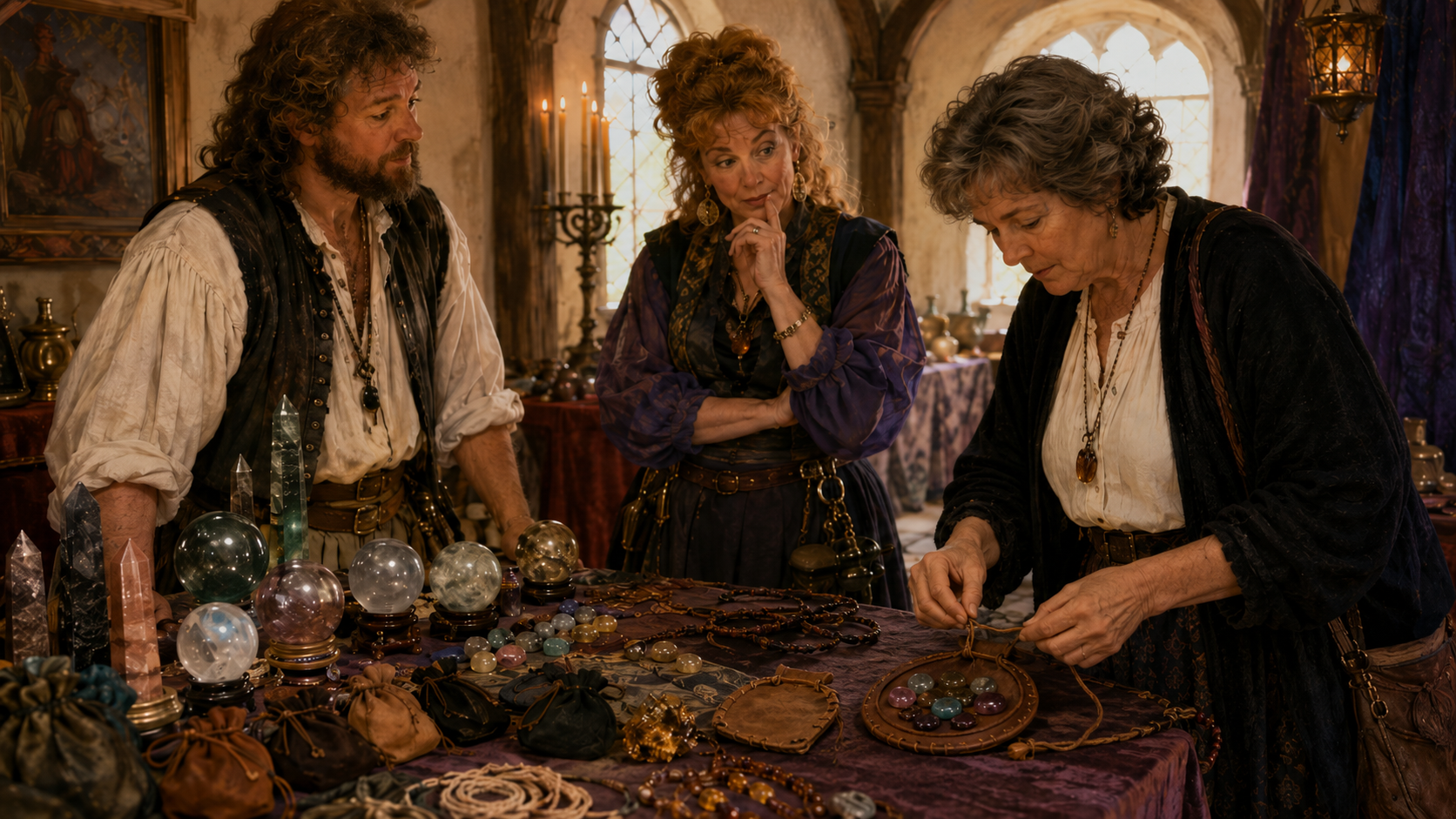
I continued, “They can also look up the traditional properties associated with each stone, some of which are based on writings dating back to the 1500s. I have forty-eight different stones for them to choose from.” Linda thought about it for a moment. “That’s not really a craft,” she said. “It’s more of an activity…an event.” I shrugged and smiled. “Well, for five bucks, that’s what they can do.” Linda looked over the display again. “I’ve got to get Phyllis over here. She needs to see this because, honestly, I don’t know what to make of it.”
She called over Phyllis Patterson, the woman who had founded the original Renaissance Pleasure Faire in 1962 and who, in 1990, was still involved in evaluating prospective vendors. Phyllis came over and quietly studied my display. Then she noticed my Amber Trade Route map. She picked it up, examined it carefully, and set it back down on the table—upside down. Linda and I stood there watching her. I leaned toward Linda and whispered, “Well, this is either a good sign or a bad sign.”