
Getting Accepted into the Faire: Part 2
I looked at Linda and said, “That’s probably a good thing.” Phyllis immediately understood what I had done with the map. She appreciated the way I had connected the products we sold with history and geography, and she told me that with this concept, I could represent practically the entire world at the Faire. Because Phyllis was the final authority, her approval meant one thing: we were in. We then discussed how much space I would need. At the time, I didn’t really know what I was doing, so I figured a 10-by-10-foot booth would be plenty. Phyllis disagreed. “You need a bigger space,” she said. I thought she was exaggerating, so I stuck with the 10-by-10 booth.
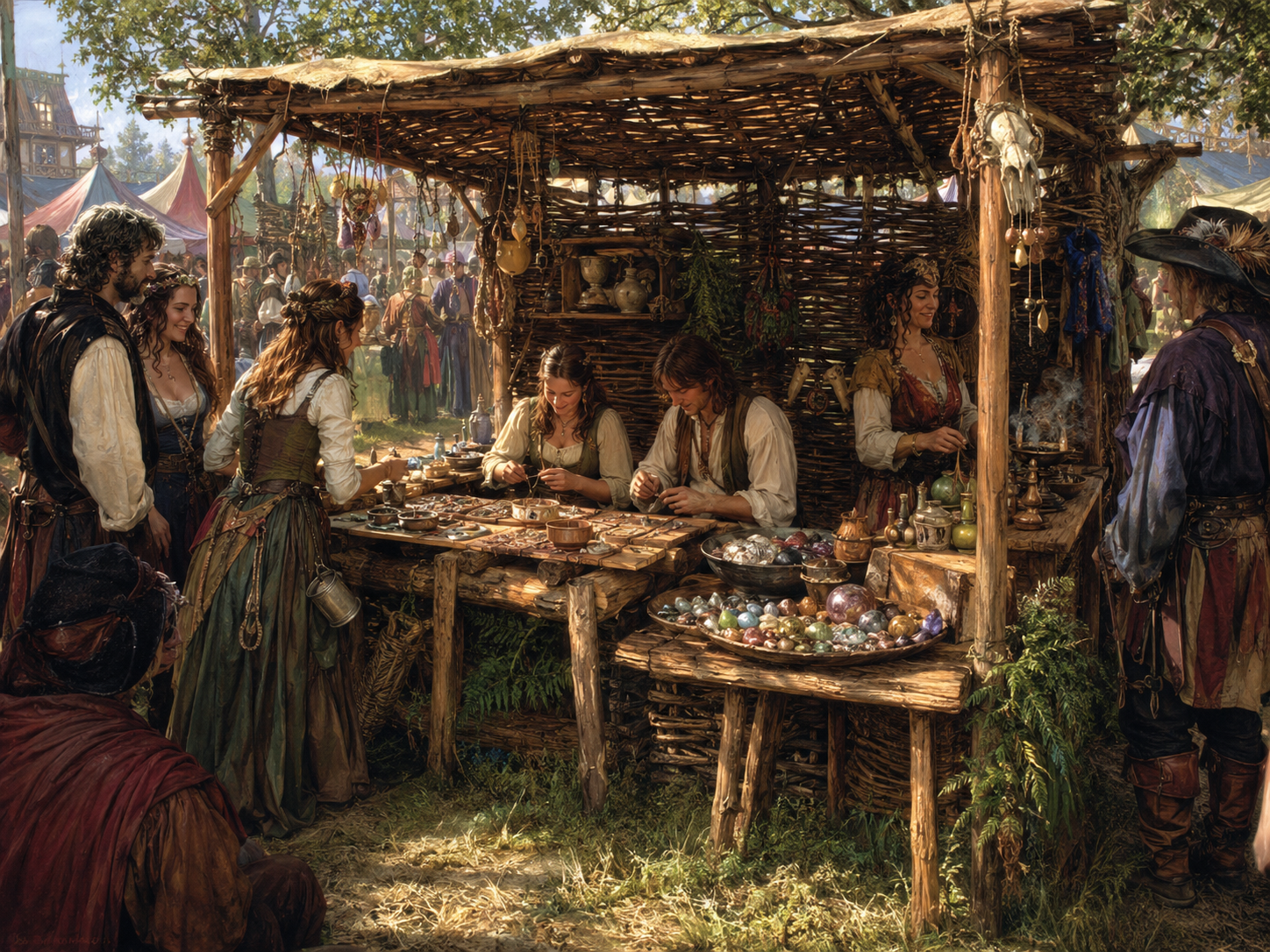
We built our display using peeler logs for the tables and woven willow branches for the walls, creating a rustic enclosure. The amulet-making area occupied one section, the stones were displayed in another, and the resin incense was arranged off to the side. There was only one problem: we had used freshly cut willow branches, complete with all their leaves. When the fire department came through for the booth inspection, they informed me that every single leaf had to be removed before we could open. That was my introduction to just how many rules there were at the Faire. Even so, that very first booth we built for the Renaissance Pleasure Faire in the spring of 1990 won the Booth Building Award an award we didn’t even know existed.
When the Faire opened, the crowds poured in. By the end of the first day, the grass had been completely worn away in the areas where visitors naturally gathered around our booth. It taught me an important lesson about how people move through a space and what naturally captures their attention. Everything had come together remarkably well. We were officially part of the Renaissance Pleasure Faire. That spring of 1990 marked the beginning of what would become an unforgettable chapter in our lives.