
Becoming Part of the Renaissance Pleasure Faire: Part 2
After my experience at the fair and being completely amazed by what I had discovered—we decided we wanted to become part of it. The following Monday, I went looking for Phyllis Patterson, founder of the Renaissance Pleasure Faire. Phyllis had started the original fair in 1962 as a history project connected to her teaching. An elementary school history teacher, she first held the event in her backyard. From there, it grew into a public event, eventually moving to Agoura, California, where it remained for two decades before relocating to San Bernardino.
When we met, I sat down and got right to the point. “I want to be a vendor.” Phyllis quickly explained that becoming a vendor was not that simple. First, I needed to come up with an idea that no one had presented during the fair’s 28 year history. Second, I needed a craft. Every vendor made what they sold. Then she looked at me and asked, “What’s your craft?” I had only one answer. “I don’t have one,” I admitted. That challenge stayed with me.
Around the same time, I had been studying the history of beads through the work of Lois Sherr Dubin. Her research described merchants traveling ancient trade routes that connected England and the Baltic region with Venice and, from there, destinations throughout Arabia, Turkey, India, Nepal, China, and Africa. Traders carried amber from the Baltic, exchanged goods for Venetian glass trade beads, and collected incense, resins, stones, and other treasures as they traveled from one culture to another.
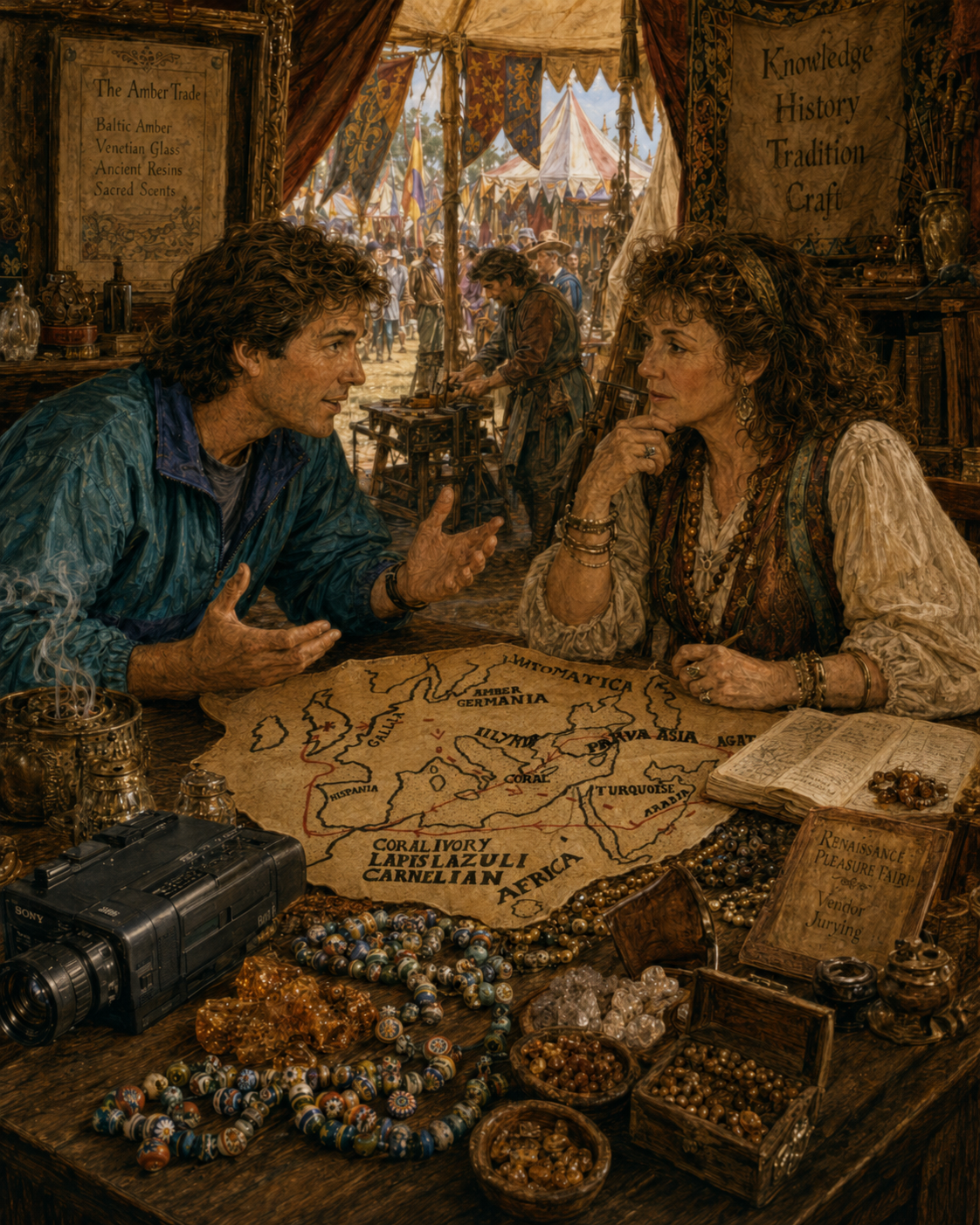
I began imagining myself as one of those merchants, traveling the Amber Trade Route and returning with amber beads, Venetian glass, incense, resins, crystals, and unusual treasures from distant lands. The more I thought about it, the more the idea seemed to bring together everything I loved history, trade, culture, geography, unusual objects from around the world, and, most of all, the people connected by those journeys.
To bring the concept to life, I hired an artist to paint a map on pigskin depicting 16th century Europe and the trade routes my merchant might have traveled. Knowing Phyllis had been a history teacher, I hoped she would appreciate the historical foundation behind the idea. I also returned to the fair carrying my video camera which, in those days, was roughly 16 inches long and 8 inches high. I walked the grounds carefully, filming and studying the booths because I wanted to be absolutely certain no one else was presenting anything similar. Eventually, I assembled my display and prepared for the jurying process, when prospective vendors presented their crafts, products, and concepts for consideration.
By then, it was the following spring. I had taken Phyllis’s challenge and turned it into something I could finally present. Now came the real test: would the Amber Trade Route merchant become part of the Renaissance Pleasure Faire?